


Welcome to Stone Restoration Services Ltd.
Striving to attain the high standards demanded of a modern stonemasonry company without neglecting the old values that are required of such an exacting industry is the hallmark of Stone Restoration Services Ltd.
Read more about the company

Whitehall
Whitehall redevelopment

Christchurch Spitalfields Award winning sympathetic conservation & restoration

Museum of Childhood
SRS ensure stonework was cut and fixed perfectly

Bancroft School
SRS are proud to be the contractor for the School



Stone Restoration Services Ltd
Unit 12 Communal Site
Anchor Lane
Abbess Roding
Ongar
Essex
CM5 0JR
Tel: 01279 876994
Fax: 01279 876995
Email: info@stonerestorationltd.co.uk
Registered office:
15 Whitehall
London
SW1A 2DD
Registered in England No.3507284

'Pointing' is the mortar between bricks - the visible edge of the mortar joint.
Maintenance and repair to the pointing and bricks will not only enhance the structure aesthetically but also retain its historic features - periodic replacement is vital to secure the longevity of the building and modern day value.
The deterioration in pointing will eventually lead to the poor performance of the building as a whole. The mortar element will have a lesser life span than the other materials used in construction,. The failure of the mortar will result in:
- The ingress of water into the external fabric of the building and subsequently internally for pre-cavity constructed buildings.
- Frost damage, indicated by the shelling of the face of the construction materials
- Structural damage that will eventually affect the building fabric if the two previous stages of obsolescence are not addressed. Subsequently, costly reconstruction may be required
- Originally bricks were "glued" together with a lime/sharp sand mortar which has the advantage of being porous, flexible and suitable for the soft bricks being used at the time. From the 19th Century sharp sand/cement has been more commonly used as it is much harder and impervious to water - also suiting modern hard bricks.
More recently however Architects are returning to original methods of lime/sand not only due to economical decline in cement availability but more importantly the preference of flexibility and to avoid the risk of the mortar failing to make the required bond with the original lime mortar.
In the early 19th Century it was always preferable to have no visible mortar - this was achieved by:
- Using high quality engineering bricks
- 'Rubbed' brickwork, where bricks are rubbed together until they fitted closely together.
- 'Tuck' pointing, where a line of white, putty mortar was 'tucked' into a slot cut in stained mortar
- Stained mortar to hide the pointing
All of these services are readily available from Stone Restoration Services Brick Restorers today together with all other forms of pointing including flush, tuck, bucket handle, weatherstruck and recessed.

In most cases tuck pointing was originally used to disguise poor quality, chipped and irregular bricks.

To the left is an example of tuck pointing. The bricks have been pointed with a stained mortar and then a line of putty mortar set in. The white putty is a mix of silver sand and lime.
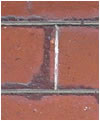
In the example to the right, the line is on the surface - this disguises the irregular brick and to the general eye suggests a regular-sized brick.

Our brick restorers offer a full mortar matching service. Powder form coloured mortar mix is added to the dry sand and a test carried out to ensure virtually all the bricks match - modern pigments can also be eradicated by sourcing specialist organic colourings.
Once accurate results are achieved suitable quantity batches are made to ensure consistent results throughout the project.

Prior to the 19th century bricks were only used in houses for chimneys to reduce the risk of fire however their popularity rose and "yellow stocks" became common in London - however with the introduction of "red" bricks the yellows were relegated to the rear of buildings.
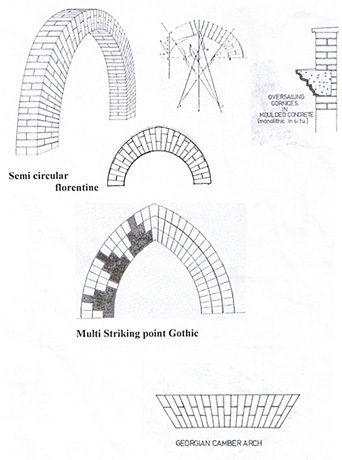
We at Stone Restoration Services have the depth of knowledge required to understand that bricks are anything other than simple - 'Stock', 'brindle', 'diaper', 'faience', 'bond', 'gault', 'tuck-pointing', 'header', 'fletton' are all common place with our own brick specialists.
We have close working relations with all suppliers of bricks - new and reclaimed and can readily source any bricks for contracts new or old.
We ensure all our employees are developed and trained in both traditional methods and of course any new and upcoming methods. We actively participate in apprentice courses for all our brick restoration staff.
We are aware of the need to develop future generations in traditional methods of laying/mortar mixes and repairs to ensure the historic nature of any building is preserved.

Prior to the 19th century bricks were only used in houses for chimneys to reduce the risk of fire however their popularity rose and "yellow stocks" became common in London - however with the introduction of "red" bricks the yellows were relegated to the rear of buildings.
We at Stone Restoration Services have the depth of knowledge required to understand that bricks are anything other than simple - 'Stock', 'brindle', 'diaper', 'faience', 'bond', 'gault', 'tuck-pointing', 'header', 'fletton' are all common place with our own brick specialists.
We have close working relations with all suppliers of bricks - new and reclaimed and can readily source any bricks for contracts new or old.
We ensure all our employees are developed and trained in both traditional methods and of course any new and upcoming methods. We actively participate in apprentice courses for all our brick restoration staff.
We are aware of the need to develop future generations in traditional methods of laying/mortar mixes and repairs to ensure the historic nature of any building is preserved.